


ROI on Dual Occupancy Developments in Australia: Is It Viable
Updated: 3 days ago
Two homes on one block do not automatically mean twice the return. In Australia, dual occupancy means two dwellings on one lot. The ROI on dual occupancy developments in Australia depends on whether the site, approvals, project costs and local rental demand support a viable outcome.
The appeal is straightforward: two dwellings can provide two rental income streams from one property. But rent is only part of the picture. Site suitability, planning constraints, construction and holding costs, and whether you intend to retain or sell the dwellings all affect the result.
This article explains what dual occupancy involves, how approvals and project stages affect feasibility, and why location and tenant demand matter when estimating returns. Use these factors to assess whether a project aligns with your investment objectives and the long-term value you want from the site.
Table of Contents
What Is Dual Occupancy?
In NSW, dual occupancy means two homes on one lot. Attached dwellings share a common wall, and having two dwellings does not automatically create separate titles. Duplex commonly describes two attached homes, while subdivision changes land ownership boundaries and requires a separate approval pathway.
For investors, the central attraction is potential income from both dwellings. Renting each can create two rental income streams from one property, while selling both may produce a different return. Compare projected rent or sale proceeds with acquisition, construction, finance, insurance and holding costs. An A$80,000 capital gain would equal a 12.9% gain on that investment, before other costs.
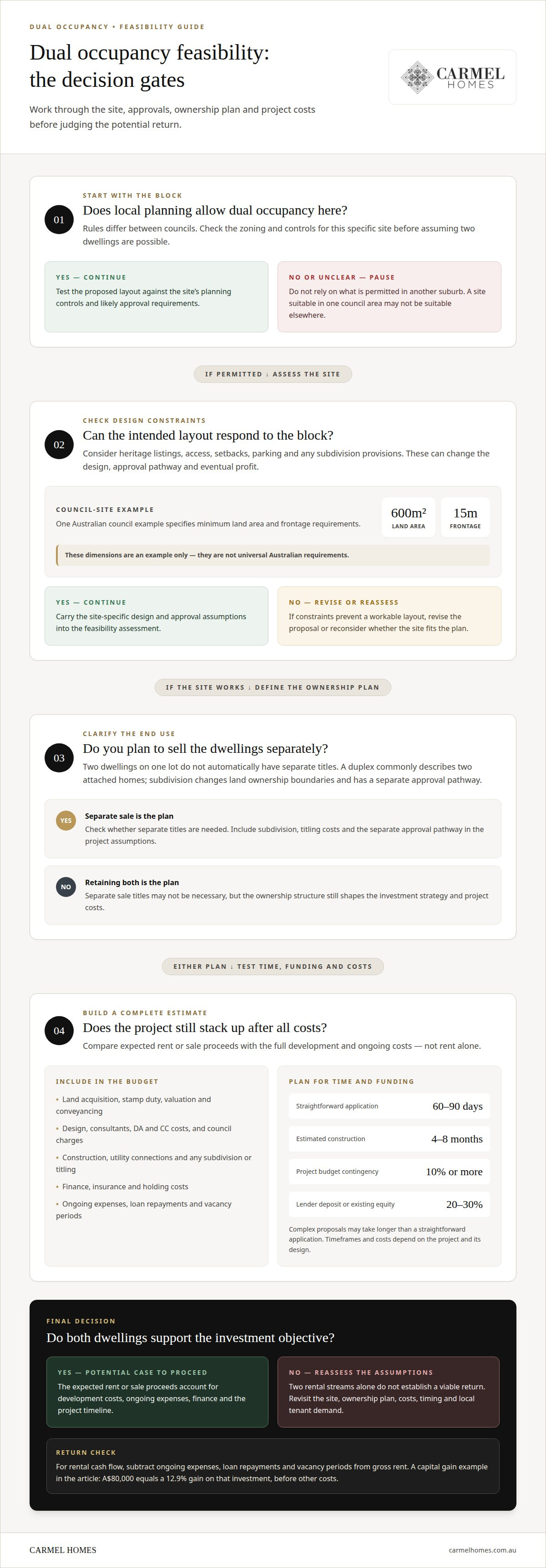
Rental income alone does not show cash flow. Subtract ongoing expenses, loan repayments and vacancy periods from gross rent to estimate what remains. Feasibility should also test whether setbacks constrain the layout and whether subdivision or separate titles are part of the plan. Dual occupancy may offer higher yields than a comparable house, but the outcome depends on rent, site conditions and total project costs.
Two dwellings can generate two rents, unlike a single-dwelling investment, while a house-and-land investment has its own land and rental economics. A duplex may be an attached form of dual occupancy. Subdivision can create separately titled lots and add costs. Stamp duty is an acquisition expense, and GST may need to be included depending on how the project operates. Capital gains tax treatment depends on ownership and sale circumstances.
Owner-occupiers and investors may have different lending assessments, while repayments and interest over the loan period affect cash flow. Lenders typically require a 20-30% deposit or equity in an existing property for dual occupancy developments. Loan-to-value ratios and interest rates therefore influence borrowing capacity, finance costs and the projected return.
Council zoning and approval requirements
A duplex proposal must fit the zoning and planning controls applying to its specific block. Requirements differ between councils, so a site suitable for dual occupancy in one suburb may not permit it elsewhere. Heritage listings, access, setbacks, parking and subdivision provisions can influence the design, approval pathway and eventual profit. An Australian council site example requires at least 600m² of land and a 15m frontage, but these dimensions are not universal.
Before acquiring land, test the proposed layout against local controls and likely approval costs. Include estimated development application (DA) and construction certificate (CC) costs alongside purchase and construction assumptions. In NSW, a secondary dwelling, such as a granny flat, is distinct from dual occupancy and must be on a lot with a principal dwelling. This distinction affects how the proposal is assessed.
Approval timing also affects holding costs. A straightforward dual occupancy application in Australia typically takes 60-90 days, while complex proposals may require further design work or assessment. During planning, an existing house on a corner block may be rented while approval is sought, helping offset holding costs. Access from two streets can also shape vehicle entry and dwelling layout, subject to zoning and other controls.
Canberra illustrates how rules can vary by location and date. From 1 July 2026, RZ1 blocks have no minimum size for building a second dwelling, while a standard block must be at least 600 square metres for unit titling. Since that date, each new subdivided block under the Missing Middle reforms can be at least 350 square metres if it has, or will have, a lawfully built dwelling. These rules are specific to Canberra, not national standards.
Approval is only one part of project feasibility: expected rent or sale proceeds must account for planning time and related holding costs. A carefully composed dual occupancy design can respond to the site’s constraints while supporting the intended investment strategy.
Acquisition, construction and subdivision process
Complete a site feasibility assessment before signing a contract of sale. Allow for land acquisition expenses, including stamp duty, valuation and conveyancing, as well as likely design, approval and construction requirements. Utility connection fees can also add to capital needs, particularly when a knockdown rebuild involves multiple dwellings.
Construction costs depend on the site, design and scope of work, so there is no single typical total for Australian dual occupancy. A full estimate should account for construction, consultants, council charges, finance, holding costs and any required subdivision or titling. Include a contingency of 10% or more in the project budget, allowing room for unexpected work without treating that allowance as a forecast of actual costs.
Design choices affect both the construction programme and future use. An attached layout shares a wall, while two detached dwellings need a different site arrangement. A granny flat is a secondary dwelling, not the same planning category as dual occupancy. Confirming the intended ownership structure early helps clarify whether separate titles and their associated costs are needed.
Construction of an Australian dual occupancy is estimated to take 4-8 months, depending on project complexity and design choices. A fixed-price contract can provide a more reliable construction-cost forecast, while clear documentation helps align the agreed scope with the design. Staging, site access and the relationship between the two dwellings can also affect how efficiently work proceeds.
If you plan to sell the dwellings separately, check whether separate titles are needed, as titling can add to project costs. If you plan to retain both, separate sale titles may not be necessary, but the ownership structure still shapes your investment strategy. Assess acquisition, construction, holding and titling costs together for a clearer view of the capital required and potential profit.
Stamp duty may apply as a land acquisition expense.
Suburb selection and rental demand
ROI measures the return against the capital invested. For a rental assessment, divide annual rental income by total investment, then multiply by 100; a net calculation subtracts operating expenses first. This gives investors a consistent basis for assessing the ROI on dual occupancy developments in Australia.
Location affects achievable rent and how long a dwelling may remain vacant. Look for sites near infrastructure and amenities, with a surrounding residential character that suits likely tenants. Consider public transport, employment and everyday services, then check whether each home’s layout fits the needs of households seeking housing in the area.
Gross yield excludes expenses, so it does not show cash flow after council rates, insurance, maintenance, management and finance. Estimate net income by accounting for these costs and potential vacancy periods.
In Canberra, assess rental prospects for each suburb and dwelling rather than assuming both homes will attract the same tenants. Compare each home’s size, privacy, access and parking with local tenant needs. This helps test whether projected rent is supported by the design and the property’s position in the local housing market.
Rental demand and capital growth are separate parts of a return assessment. Compare expected income with longer-term value prospects, using consistent investment periods and cost assumptions. This gives you a more considered basis for assessing ROI on dual occupancy developments across Australia.
For a site-specific design shaped around dwelling layout and intended residents, discuss your dual occupancy plans.
Carmel Homes: Dual Occupancy
Carmel Homes can help owners assess whether a dual occupancy project suits their block and long-term plans. Its Custom Design and Build service can shape a two-dwelling design around the site, intended use and architectural preferences, rather than relying on a generic layout.
Early design discussions can turn feasibility findings into a practical brief, including how the dwellings relate to one another and whether a Knockdown Rebuild suits the property. For a distinctive architectural direction, French Provincial Luxury Homes can inform a design tailored to the project.
Turn to Carmel Homes when you are ready to move from evaluating potential returns to considering how a thoughtfully designed development could take form. Contact Carmel Homes to discuss your dual occupancy plans.
Shape the next stage of your property plans
Assess the ROI on dual occupancy developments in Australia alongside the future you want the property to serve. A well-resolved design can support your investment strategy while respecting the site and the people who may one day call each dwelling home. Start by shaping a clear project brief that brings together intended use, design direction and site considerations.
Carmel Homes offers Custom Design and Build, Knockdown Rebuild and French Provincial Luxury Homes to support the design and construction decisions behind a dual occupancy project. Whether you are starting with an existing residence or a preferred architectural style, contact Carmel Homes to discuss how your plans could take shape.
Discuss your project with Carmel Homes, and take the next step towards a design shaped around your property and long-term intentions.
Frequently Asked Questions
What are current construction costs per square metre for dual occupancy homes in Australian states and territories?
There is no single comparable rate across Australia: estimates depend on location, design, site conditions and construction scope. A duplex and two detached homes may require different specifications and site works. For a useful comparison, separate building work from demolition, consultant, utility, approval and finance expenses, then compare them against the same dwelling size and inclusions.
What rental yields and vacancy rates can dual occupancy properties achieve in major Australian cities?
Rental yield and vacancy depend on the property and local tenant demand, rather than the city name alone. An illustrative Australian example puts gross yield at 6.1% of total investment, before expenses. Assess each dwelling’s expected rent separately, and consider how its layout, privacy and likely tenant group may affect leasing prospects and vacant periods in its suburb.
What are the main risks and delays in dual occupancy developments, including cost overruns, approvals and tenant demand?
Key risks include planning constraints, design changes, unexpected site work, utility connections, finance and delays that extend holding costs. A layout that does not suit local tenants can also weaken leasing prospects. Map dependencies before committing: approval changes may require design revisions, while construction changes can affect both budget and timing. Keep separate allowances for site uncertainty and market exposure.
What steps should investors take to assess feasibility and estimate ROI for a dual occupancy site?
First match the investment strategy to the site: decide whether your goal is rental income, separate sales or long-term ownership. Review title constraints, planning overlays, access and services, then test whether the layout suits likely residents. Build separate rental and sale scenarios, and vary vacancy, interest and construction assumptions to identify which factors most affect projected returns before committing capital.
What taxes, stamp duty, GST and capital gains tax may apply to an Australian dual occupancy development?
Stamp duty may apply as a land acquisition expense. GST may need to be included depending on how the project operates, while capital gains tax treatment depends on ownership and sale circumstances.


