


How to find a reputable builder for a new home in Victoria
Registration is an essential first check when finding a reputable builder for a new home. Use the relevant state and territory regulatory authority online verification tools to check the builder’s licence or registration. Confirm that it is current, review any disciplinary history and verify that the registered legal entity matches the name on the proposed contract. These checks provide a useful starting point, but they do not tell you everything about the building experience.
A custom home is a substantial personal and financial commitment, so look beyond credentials. Consider how Carmel Homes communicates, responds to concerns and supports clients during construction. A strong portfolio matters, but so does a clear, consistent process behind the finished homes.
This guide covers how to verify builder registration, assess reviews and referrals, evaluate relevant projects and visit completed homes or worksites. It also explains how to judge customer support, helping you understand the partnership involved from early ideas through to completion.
Key Takeaways
Use the VBA’s Find a Practitioner tool to check current registration, disciplinary history and whether the registered entity matches the proposed contract.
Compare builders’ portfolios with projects similar to your plans, and look for relevant experience and independent recognition.
Read reviews for their recency, volume and recurring concerns, then ask past clients about communication and how issues were handled.
Visit completed homes or worksites to assess craftsmanship and attention to detail beyond photographs.
Discuss communication, cost and timeline transparency, and support through the building process before deciding who is the right fit.
Table of Contents
How do I check if a Victorian builder is registered?
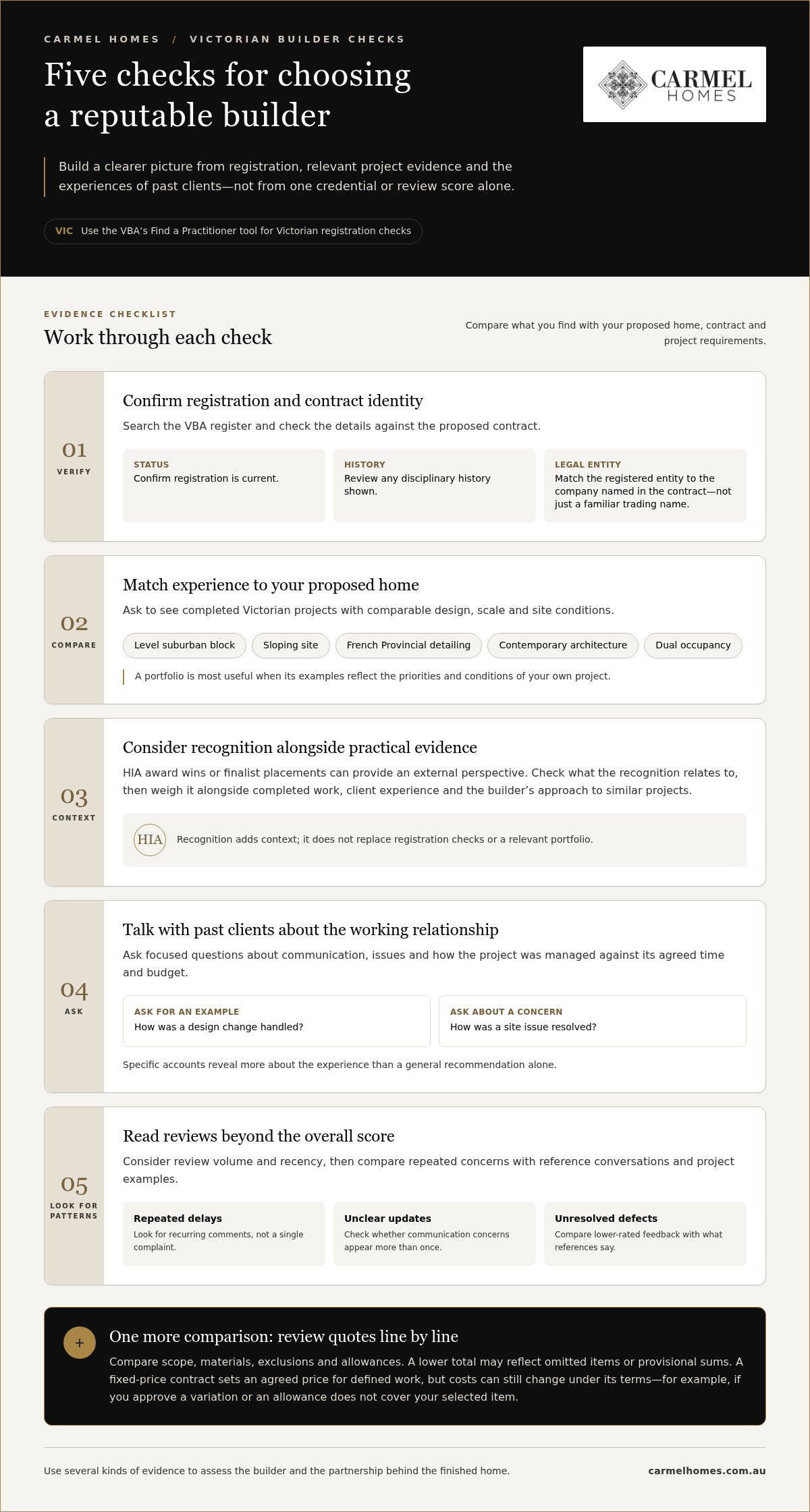
Use the Victorian Building Authority’s (VBA) Find a Practitioner tool to check a Victorian builder. Confirm the registration is current, review any disciplinary history and compare the registered legal entity with the name on the proposed contract.
Compare quotes line by line, including the scope, materials, exclusions and allowances. A lower total may reflect omitted items or provisional sums. A fixed-price building contract sets an agreed price for defined work, but costs can still change under its terms, such as when you approve a variation or an allowance does not cover your selected item.
Search the VBA register using the builder’s details. Use the Find a Practitioner tool to locate the builder, then compare the result with the business name and entity in the contract. Check that the registration is current and review any disciplinary history shown. If a company signs the contract, confirm the registered entity aligns with that company, rather than relying only on a familiar trading name.
Match experience to your proposed home. Ask to see a portfolio of completed Victorian projects with comparable design, scale and site conditions. A builder experienced in a level suburban block may have a different project history from one delivering a home on a sloping site. Look closely at examples that share your priorities, such as French Provincial detailing, contemporary architecture or dual occupancy.
Assess recognition alongside practical evidence. Industry recognition can add an external perspective, but it should sit beside evidence of completed work and client experience. Multiple Housing Industry Association (HIA) award wins or finalist placements indicate external assessment. Consider what the recognition relates to, then compare it with the builder’s portfolio, communication and construction approach for projects like yours.
Ask references focused questions. Speak with past clients about how the builder communicated, dealt with issues and managed the project against its agreed time and budget. Ask for a specific example, such as how a design change was handled or how a site concern was resolved. Concrete accounts reveal more about the working relationship than a general recommendation alone.
Read reviews for patterns, not a single score. Consider the number and recency of reviews, then look for repeated concerns in lower-rated feedback. Separate a one-off complaint from recurring comments about delays, unclear updates or unresolved defects. Compare those themes with reference conversations and project examples, so your assessment reflects several kinds of evidence.
Which Home Builder Has the Best Reputation in Victoria?
No single measure tells you everything about a builder’s reputation. Check the business identity, credentials, financial safeguards and project record separately.
Research the builder’s businessSearch the business name and legal entity, then compare them with the proposed contract. Take time to resolve inconsistencies or unanswered questions, and do not sign before you have reviewed the documents. A stronger picture of reputation emerges when public feedback, client references and project evidence are consistent.Australian contract and cooling-off conditions vary by state or territory and by contract. Before signing, review the written scope, payment schedule, materials, timelines, variation process, dispute procedure and any cooling-off clause. There is no single useful cost or timeline for every new home: design, materials, site conditions, approvals and construction scope all affect the project.
Check licences and industry credentialsCheck Victorian registration through the VBA’s Find a Practitioner tool. Confirm the current status, review disciplinary history and ensure the legal entity matches the contract. Industry credentials can provide additional context, but they do not replace registration checks or a relevant portfolio.The Housing Industry Association (HIA) judging process assesses building businesses on documentation, customer communication, financial management and site quality. HIA awards or finalist placements provide external assessment to consider alongside other evidence. iCIRT ratings are another reference for rated building professionals, but the iCIRT Register is a NSW-based search resource and does not replace Victorian registration checks.
Verify insurance and work restrictionsFor a NSW project, contractors must obtain Home Building Compensation Fund insurance for work over A$20,000 before starting or accepting payment, including a deposit. NSW clients should also check public liability and workers compensation insurance, and search the register of building work orders for current orders or restrictions. These are NSW-specific checks, not Victorian rules.Watch for warning signs such as mismatched business details, unexplained payment pressure, reluctance to provide written information or recurring reports of unresolved problems. The HIA’s assessment of financial management also makes financial conduct relevant when reviewing credentials. For a considered approach to a distinctive home, explore custom home design and build.
Online research and personal referrals
Use online reviews and personal recommendations as complementary evidence, not as a final verdict on their own. When finding a reputable builder for a new home, compare what people say with the builder’s work and your project requirements.
Search for sustained review patterns. Read reviews across platforms, including ProductReview.com.au, and consider their number and recency. Look for sustained scores of 4.5+ stars, while remembering that a rating cannot describe every client’s experience. Read lower-rated feedback carefully: repeated concerns about communication or unresolved issues deserve attention. Check whether responses address the specific concern, rather than relying on the star score alone.
Compare comments with your priorities. Look for feedback about construction details that matter to your project, such as design changes, progress updates, issue resolution and handover. A review describing a straightforward home may offer limited insight if you’re planning a highly tailored design. Sort comments by date where possible, and consider whether recent experiences differ from older accounts.
Ask for personal referrals with relevant context. Speak with friends, family or colleagues who have built a home, then ask what kind of project they completed. A recommendation from someone whose design or site needs resemble yours may offer more relevant insight than a general endorsement. Ask what communication was like, how concerns were handled and whether the finished home reflected their expectations.
Turn each recommendation into a specific enquiry. Ask the person referring the builder to describe a clear example, such as a design decision that changed or an issue raised during construction. Find out how the builder explained options and kept the client informed. If a referral comes only from a display home visit or online impression, treat it as context, not evidence of a completed client relationship.
Cross-check names and evidence. Compare the business discussed in reviews with the builder’s website and public portfolio. Confirm that examples relate to the same business, rather than a similarly named company or project partner. Record recurring strengths and concerns, then compare them with what references say. When finding a reputable builder for a new home, this cross-check helps distinguish consistent feedback from a persuasive online presence.
Visiting completed homes and worksites
Photographs show how a home looks, but an in-person visit can reveal how its construction serves everyday use. Arrange to view completed projects, display homes or current worksites, and assess the workmanship and attention to detail for yourself.
Choose visits that relate to your plans. Ask to view completed homes with features similar to your design, such as a two-storey layout, detailed façade or open-plan living area. A project with comparable materials or architectural details can help you assess the finish. Note what matches your brief and what differs, as a display home may have a different specification.
Look closely at finishes and junctions. In a completed home, inspect how doors meet frames, cabinetry aligns, tiles join and paint finishes around corners. These details show the care taken where materials meet. Check repeated elements, such as window reveals or stair balustrades, rather than judging craftsmanship by one striking feature. Record your observations to compare across visits.
Consider how the home functions. Walk through the rooms in the order you might use them, from the entry to the kitchen, living areas and bedrooms. Notice circulation, storage, natural light and the connection between indoor and outdoor spaces. For example, consider whether a kitchen island allows comfortable movement around it. Ask how the design reflects the owners’ priorities.
Arrange a suitable current worksite visit. Ask whether you can view a project at an appropriate construction stage, and follow the site’s access arrangements. Observe site organisation, material storage, work in progress and how completed work connects with the next stage. A worksite offers a different perspective from a finished home, where plaster, flooring and fittings may conceal earlier construction details.
Use each visit to ask focused questions. Bring notes about what you observed and ask how the builder handled similar decisions on that project. You might ask how the junction between cladding and windows was resolved, or how a design feature was carried through several rooms. Compare the answers with what you saw, and note whether the explanations are clear, specific and consistent.
After each visit, compare your notes across the homes or worksites. A polished display is only one example. Completed projects and construction in progress offer different evidence of finish, process and care.
Customer service and building-process support
Assess how a builder listens, communicates and supports decisions throughout construction, not just in early meetings. Ask about project updates, cost and timeline transparency, how challenges are handled and what support is provided after completion.
When speaking with a builder, ask how they will understand your ideas, keep you informed, explain changes and respond to concerns. Clear answers help you judge whether the working relationship suits your project.
Assess customer service and process supportNotice whether the builder listens carefully and responds directly to your priorities. If you raise a design concern, see whether they clarify the issue and explain possible approaches instead of giving a generic answer. This early conversation can indicate how they may handle decisions during a custom build.Ask how communication works throughout the build, including who provides updates and how challenges are raised. Look for a clear explanation of how costs, timeline changes and decisions will be discussed. Poor communication can lead to surprises, delays and extra costs, so transparency matters throughout construction, not only at the start.
Prepare questions for builder interviewsBring a written list so you can compare answers across meetings. Ask: “How will you keep me updated?”, “Who should I contact about a concern?” and “How are changes and their cost or timing explained?” These questions help you assess whether the process is clear, rather than relying on broad assurances.Ask how the builder handles a site issue that affects a design decision. For example, find out what information you would receive before choosing between alternative materials or details. A useful answer explains the options, their implications and how your approval fits into the decision, so you understand your role.
Clarify responsibilities and decision points. Ask which decisions need your input, how they will be communicated and what information you will receive. If a selected finish affects another design element, you should understand the relationship before deciding. A clearly defined process helps you stay involved without having to guess what happens next.
Discuss support after handover. Ask how issues raised after you move in are received, recorded and addressed. A trustworthy builder provides after-care and responds to issues that arise once owners occupy the home. Clarify how to raise a concern and how communication continues while it is being considered.
Assess consistency, not polish alone. Compare the interview answers with the builder’s written process and the experiences shared by past clients. If explanations about updates, changes or post-completion support differ, ask for clarity before making a decision. For a considered conversation about how your ideas can be carried through a custom home project, discuss your custom home project.
Carmel Homes: Custom Design and Build
If you want a home shaped around your vision rather than a standard plan, Carmel Homes offers Custom Design and Build. This may be a natural next step if you are considering a Knockdown Rebuild or want a distinctive architectural direction, such as French Provincial character or a modern custom design.
Bring your preferences, site considerations and questions about the building process to an initial conversation. You can discuss how design decisions and construction can come together for your project, considering the home’s character and practical requirements as a whole.
To discuss your ideas, contact Carmel Homes at carmelhomes.com.au.
Shape the next step around your vision
The next step is to turn your priorities into a clear design conversation. As you continue finding a reputable builder for a new home, consider whether the discussion gives proper attention to how you want to live, the character you admire and the practical demands of your site. These preferences can guide a home that feels personal and considered, rather than shaped by a standard template.
Carmel Homes offers Custom Design and Build, Knockdown Rebuild and French Provincial Luxury Homes. These services may suit you if you are building a new residence, replacing an existing home or drawn to a distinctive architectural style. Start with the ideas that matter most, then explore how they can inform the home’s design and construction.
Contact Carmel Homes to discuss your plans and take a considered first step towards a home shaped around your vision.
Frequently Asked Questions
Is HIA accreditation important when choosing a builder?
HIA recognition can provide useful independent context, but it should not be your only measure. The Housing Industry Association’s judging process assesses businesses on documentation, customer communication, financial management and site quality. Consider what an award or finalist placement relates to, then weigh it against your project’s needs. Recognition for a different project type, for example, may say less about a builder’s experience with your design.
What is the most trusted home builder in Melbourne?
There is no single builder that is the right choice for every homeowner or project. Suitability depends on your design, site, communication preferences and the evidence you value. Create a shortlist based on relevant completed work, clear answers and consistent client feedback. Then compare how each builder would approach your brief, rather than treating a general ranking or award as a universal recommendation.
What should I look for in a home builder’s reviews?
Look for detailed accounts of a specific project experience, rather than brief praise or criticism without context. Notice whether a reviewer explains what happened, how the builder responded and whether the issue was resolved. Read the builder’s reply, too: a measured, specific response may offer more insight than a defensive or generic one. Compare several accounts before drawing conclusions from a single review.
How do I check whether a builder is licensed and registered in Australia?
Check the regulator for the state or territory where the building work will take place, as registration and licensing arrangements differ across Australia. In Victoria, use the VBA’s Find a Practitioner tool and search by the builder’s name or business details. Compare the result with the legal entity named in the proposed contract. For a project elsewhere, use the relevant building regulator in that jurisdiction rather than relying on a Victorian search.
How do I verify a builder’s insurance, financial stability and disciplinary history?
Ask to see the insurance documents relevant to the project and check that the named business matches the contracting entity. Ask the builder about any disciplinary history as part of your assessment. The HIA assessment process also considers financial management. To assess financial arrangements, examine the proposed scope, payment schedule and written explanations for variations. Insurance and building requirements differ by jurisdiction, so distinguish local requirements from rules that apply elsewhere.
Where can I find reviews and references for Australian home builders?
Use independent review platforms alongside referrals from people who have completed a build, and ask builders for references from past clients. Find out what type of home the person built and whether their experience relates to your priorities. Ask whether you can discuss a particular stage, such as design decisions or handover. Comparing first-hand accounts with written reviews can reveal context that either source alone may miss.
How do I check a builder’s experience with my home design, site and local council requirements?
Ask to see completed projects with design features and site conditions similar to yours, then discuss how the builder approached those constraints. A sloping block or heritage-inspired façade, for example, can raise different design questions from a level site and contemporary exterior. Ask how the project’s planning requirements were identified and managed, and what information informed the design. For your own site, review the relevant council planning controls before settling on a design.


