


French Provincial Landscape Design: Luxury Garden Guide
A French provincial garden balances order with an easy, rural character. French Provincial landscape design often draws on symmetry, geometric lines and clipped greenery, while a country-inspired interpretation can feel looser, with colourful bordered beds, rustic paths and considered planting. The result is not a rigid template, but a garden shaped around the home and the way you want to use it.
That distinction matters: formal structure creates a composed, architectural setting, while softer arrangements feel more relaxed and welcoming. Both can read as distinctly French when the details are carefully chosen and work in harmony.
This guide explores the defining elements, from fountains and stone pathways to planting areas and outdoor entertaining spaces. You’ll see how each feature shapes the garden’s atmosphere, and how planning the relationship between the house, landscape and daily life can bring the composition together.
Table of Contents
What makes a French provincial garden?
A French provincial garden balances architectural order with country character, pairing clipped forms with relaxed planting. Its layout can be formal or informal, shaped by the home, the outlook and the preferred level of structure.
Formal and Informal Garden Styles
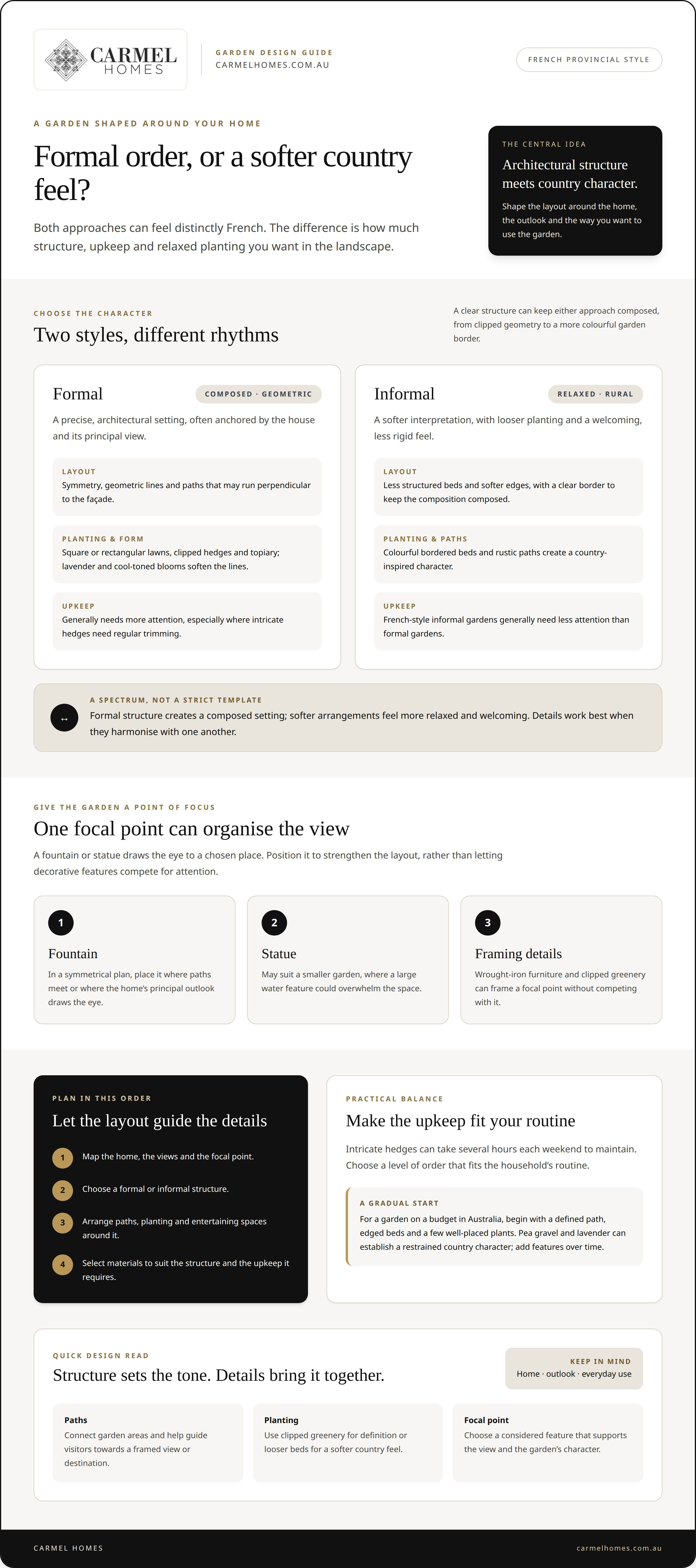
Formal French gardens use symmetry, geometry and trimmed hedges; informal French country gardens favour looser beds and softer edges. The choice affects how the garden relates to the home and how much upkeep it requires.
In a formal layout, the house often anchors the view. Paths may run perpendicular to its façade, while square or rectangular lawns reinforce the geometry. Hedges and topiary can define separate spaces; lavender and cool-toned blooms soften the precise lines. French country beds can be more colourful and less structured, but a clear border helps keep them composed.
Promenades can guide visitors towards a framed view, statue or water feature, while designed landforms and planting create an artificial landscape. Chinese garden ideas influenced European garden design: Father Attiret described Chinese gardens in letters written in 1743, translated and published in 1752, and Sir William Chambers published a book on Chinese buildings and gardens in 1757. These ideas helped shape the Anglo-Chinese style, which favoured more naturalistic scenes over strict geometry.
Statues and Fountain Focal Points
A statue or fountain creates a visual anchor, drawing attention to a chosen point. Its position can strengthen a central axis or make a destination along a garden path.
In a symmetrical plan, place a fountain where paths meet or where the house’s principal outlook naturally draws the eye. A statue may suit a smaller garden, where a large water feature could overwhelm the space. Wrought-iron furniture and clipped greenery can frame either focal point without competing with it.
Maintenance and Practical Considerations
Maintenance is part of the design. Formal gardens generally need more attention than informal French-style gardens, especially when intricate hedges require regular trimming. The upkeep can take several hours each weekend, so choose a level of order that fits the household’s routine.
To create the style on a budget in Australia, start with a defined path, edged beds and a few well-placed plants, then add features over time. Pea gravel and lavender can establish a restrained country character without requiring every area to be completed at once.
To plan and build the garden, map the home, views and focal point first. Then arrange paths, planting and entertaining spaces around them. Choose a formal or informal structure before selecting materials, as that decision guides both the layout and ongoing upkeep.
Water features and decorative elements
Water features and decorative details add texture, sound and a sense of destination to French gardens. A reflecting pool can mirror the façade, while a fountain brings movement to a composed outdoor setting. In a formal garden, align the feature with a path or terrace. In a softer arrangement, place it among flowers, climbing plants and trimmed hedges. Each element should support the setting rather than compete for attention.
Stonework can connect garden features to the house and shape how people move through the space. Pea gravel, pavers and aged stone pathways suit a rural character, while bluestone, flagstone and limestone can be used for patios, borders and retaining walls. Gravel and stonework can assist drainage in rainy seasons and help keep weeds at bay. Consider how each surface meets the planting beds so loose gravel stays separate from flowers or groundcover.
The Château de Pompignan offers a historical example of a picturesque landscape garden, built mainly between 1766 and 1774. Its garden composition shows how paths, water and architectural details can create a sequence of views rather than a single focal scene. For a contemporary Australian garden, this principle can guide the placement of a fountain, terrace or framed outlook, with each feature revealed as people move through the space.
French garden influences also include rustic village scenes. At Versailles, the Hameau de la Reine was created between 1783 and 1787, with eleven houses arranged around a lake. Five buildings served as residences for farm staff. Rather than copying the hamlet, a garden can borrow its intimate scale through a small pavilion, a stone-edged pond or a path that opens onto a secluded seating area.
Begin by deciding which view matters most, then position the main feature to reinforce it. A fountain near a terrace can lend a dining area a tranquil backdrop, while a pond beside a path creates a quieter destination. If the home’s architecture and garden are being planned together, French Provincial luxury homes can be considered in relation to their outdoor setting.
Outdoor entertaining areas and planting spaces
A French provincial garden can connect entertaining with the landscape, bringing planting, seating and pathways together as one composition. Climate, outlook and the pool’s position all influence the design.
Symmetry and Poolside Planting
Symmetrical planting gives a pool area a composed frame, using balanced beds or repeated forms on either side. This can connect outdoor entertaining spaces to the home’s architecture while keeping important views open.
At Versailles, formal garden planning used ordered axes to guide sightlines. A residential pool can borrow the principle more gently, with matching beds beside a path or repeated evergreen forms around a terrace. In one garden plan, the pool and pool house were positioned partly to preserve views of trees and mountains. It illustrates how sightlines can shape planting and entertaining spaces together.
Flower beds beside a spa or in front of a pool house bring colour close to seating. Evergreens provide structure, while annuals add seasonal variation.
Greenery and Climbing Plants
Lush greenery and climbing plants soften walls, fences and garden structures, immersing outdoor spaces in planting. Their placement can create privacy and visual continuity without relying only on clipped hedges.
Groundcover can fill the spaces beneath shrubs, while climbing plants bring foliage to vertical surfaces. Around a dining terrace, thyme and rosemary provide fragrant planting and fresh herbs for cooking. Raised stone beds can elevate plants, add growing space and offer informal garden seating.
Across Australia, let the climate guide plant selection. Sunflowers and clematis suit warmer conditions, while lilacs and coneflowers are options for colder areas. Some citrus varieties are frost-sensitive, although limes, blood oranges and Eureka lemons can fruit in pots. Place potted citrus in a sunny spot and water it twice a week in summer. A local nursery can help match an orange or lemon variety to the garden’s conditions.
Informal layouts and rustic paths
Plan a French provincial garden layout around the home, key views and how each outdoor area will be used. Paths can then connect the entrance, planting beds and a quiet seating spot without imposing a strict grid.
A French country garden feels relaxed, but its paths still need a clear purpose. A gently curving route can reveal a fountain or courtyard gradually; a direct path can link the house to an entertaining area. Keep routes easy to follow with consistent materials and defined edges, using planting, stone borders or clipped greenery. These details create an inspired composition without making every section formally symmetrical.
Gravel and aged stone pathways suit this rural character, especially when paired with simple pavers at thresholds or seating areas. Pea gravel offers a softer surface underfoot, while larger stones can mark a turn or create a stable transition near a terrace. Stonework and gravel can also assist drainage in rainy seasons and help keep weeds at bay. Choose a surface that suits its setting, so the path feels part of the garden rather than an isolated feature.
Informal layouts work best when open spaces, planting and circulation are planned together. A lawn can provide a clear area for outdoor use, with a winding path following its edge rather than cutting across it. Lavender or groundcover can soften the boundary, while a bench at the end of the route creates a destination. Keep planting clear of the walking line to make the path easier to use and maintain.
For a traditional influence, borrow the calm sequence of a French village: a path past a planted edge, an intimate place to pause, then a view towards the house. If the garden forms part of a wider home vision, explore French Provincial home design as a considered starting point.
Carmel Homes: Custom Design and Build
Carmel Homes brings the home and its French provincial character together through Custom Design and Build. This is a natural next step when planning a new residence and wanting its architecture, outlook and garden setting to feel connected rather than designed as separate projects.
With French Provincial Luxury Homes, the design can reflect your preferences for enduring architectural detail and a considered relationship with outdoor spaces. For an existing property, a Knockdown Rebuild offers a path to a new home shaped around your vision. Modern Custom Home Designs are another option when a contemporary expression better suits your plans.
To discuss a home designed around your aspirations, contact Carmel Homes.
Shape a home around the life you want outdoors
Let the garden’s role in daily life guide the next decisions about your home. How you want to gather, pause or move between indoors and out can help define the relationship between rooms, views and outdoor spaces. With that intention clear, French Provincial landscape design becomes more than a style reference; it becomes part of a broader vision for how home will feel and function.
Consider what you want the setting to make room for, then bring those priorities into the design conversation. A considered plan can unite personal preferences and architectural character, rather than treating the garden as an afterthought. The result should feel distinctly yours, with choices guided by how you want to live.
Contact Carmel Homes about your garden to begin a conversation about the home you have in mind. Your vision is a thoughtful place to start.
Frequently Asked Questions
What are the key features of French Provincial landscape design?
French Provincial landscape design brings the home, garden and outdoor living areas into a unified composition. Look for deliberate proportions, repeated shapes and a restrained palette, balanced with softer planting and tactile materials. The style can feel polished without being overly grand: a modest courtyard, for example, might use a simple stone-edged bed and a carefully framed view instead of elaborate ornament.
What plants and trees suit a French Provincial garden in Australia?
Plants for a French Provincial garden depend on local sun, soil and frost exposure. Lavender, thyme and rosemary bring fragrance and culinary use, while evergreens provide a lasting framework for seasonal flowers. Citrus can grow in sunny pots, with frost sensitivity considered when choosing a variety. Combining different plant textures creates a layered garden without relying on flowers alone.
What materials are used for French Provincial paths, walls and patios?
Common choices include gravel, pavers and natural stone such as bluestone, flagstone or limestone. Use a consistent material palette to connect paths, walls and patios, then vary the finish or laying pattern to distinguish each area. For example, a stone patio can sit beside a gravel path, with a matching stone border linking the two without making their surfaces identical.
How does French Provincial landscaping compare with formal French and Mediterranean garden styles?
French Provincial landscaping usually sits between the strict geometry of formal French gardens and the more relaxed country style. Mediterranean gardens draw on a different visual language, often featuring courtyards, sun-washed surfaces and a strong connection to outdoor living. The styles can share stone and clipped greenery, but their layouts and atmospheres differ. Choose the character that best complements the home and its setting.
Which Australian climate zones suit French Provincial gardens, and what adaptations are needed?
The style can be adapted across Australia because its defining feature is the layout, not a particular climate zone. Plant choices should reflect local heat, rainfall, sun and frost exposure. In cooler settings, select plants suited to winter conditions; in warmer areas, prioritise varieties that cope with heat. Where frost is possible, take particular care with citrus, especially in exposed positions.
What maintenance do French Provincial gardens require?
Maintenance depends on how closely the design is clipped and how much seasonal planting it includes. Formal hedges and shaped shrubs need regular attention to keep crisp outlines, while informal beds allow a softer appearance. Include routine pruning, removing spent flowers and caring for paths in the garden’s ongoing upkeep. Fewer intricate shapes can preserve a composed look with a simpler maintenance routine.


