


Fixed Price vs Cost Plus: Compare Building Costs and Control
Cost certainty depends on who carries the risk when building expenses change. With a fixed-price contract, the builder agrees to complete a defined scope for the contract sum and carries the risk of ordinary cost increases. With a cost-plus contract, you pay the project’s actual costs plus a separate fee, so you carry more risk if expenses rise. The difference between fixed price vs cost plus building contracts is therefore not simply how the price is presented, but how costs, scope and incentives are managed.
Both approaches can suit a residential build, and it’s reasonable to want clarity on the final cost without compromising your design. This comparison explains how fixed price vs cost plus building contracts work, how scope changes and cost control affect the outcome, and how each arrangement shapes the builder’s incentives. Use the decision guide to weigh the options against your project’s level of detail, flexibility and budget certainty.
Table of Contents
What Is a Cost-Plus Contract?
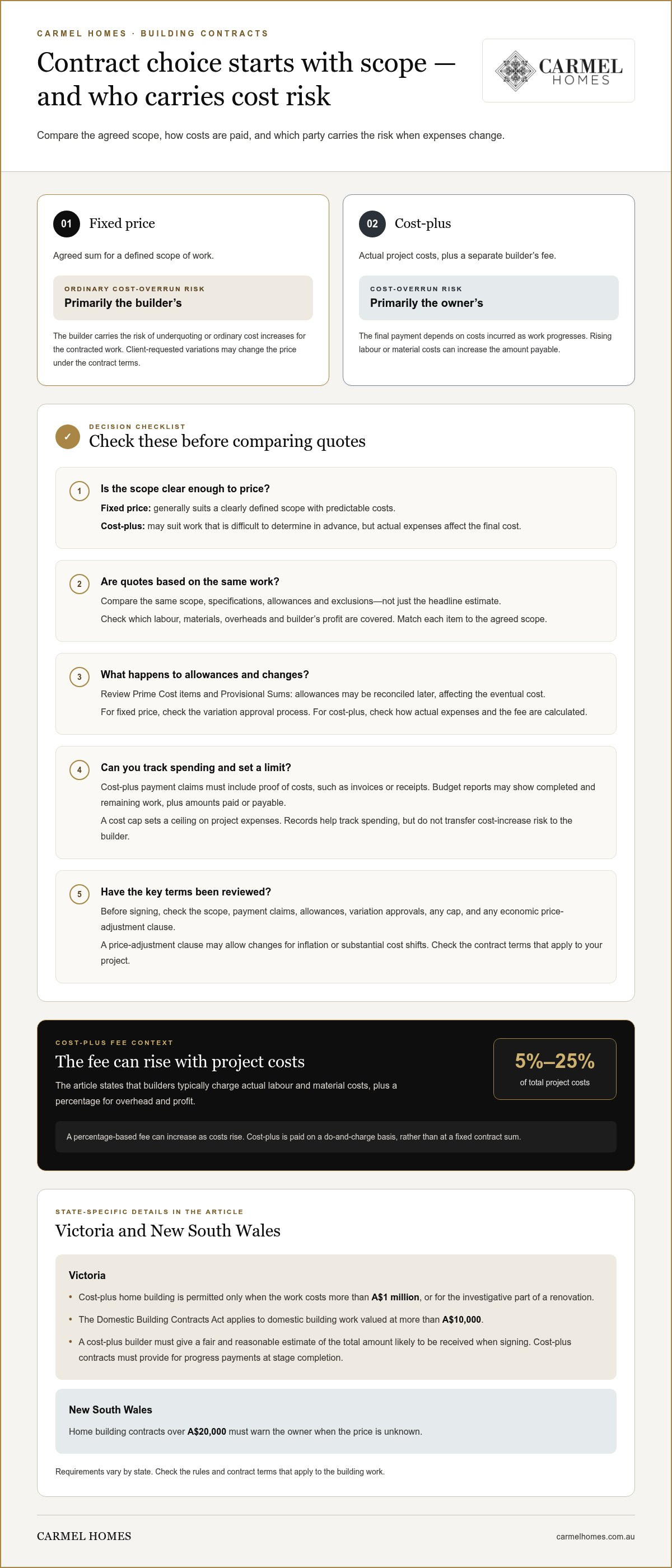
A cost-plus contract charges the project owner for actual construction expenses, plus a separate builder’s fee. Unlike a fixed-price arrangement, the final payment depends on costs incurred as work progresses.
Cost-overrun risk allocation
The owner carries more financial risk if project costs exceed expectations, because costs for the agreed building work are passed on. Increases in labour or material costs can raise the amount payable, while delays may also affect the budget. The builder’s fee is charged separately, so the contract does not set one price for the completed work.
Construction cost risk for each party
When actual costs rise, the project owner faces greater financial exposure, while the builder receives payment for costs incurred plus an agreed fee. A fixed-price contract allocates ordinary cost-overrun risk differently: the builder carries that risk for the agreed scope. This changes each party’s exposure, not just how the construction budget is presented.
Typically, the builder charges actual labour and material costs, plus a percentage for overhead and profit. Construction fees are typically between 5% and 25% of total project costs, so the fee can increase as costs rise. A cost-plus contract is paid on a do-and-charge basis, rather than at a fixed contract sum. Prime Cost items and Provisional Sums can also leave the eventual cost less certain, because allowances are reconciled later.
For cost-plus payment claims, the builder must provide proof of costs. Budget reports may be supplied monthly or on request, detailing completed and remaining work, as well as amounts paid or payable. These records help the owner track spending, but they do not transfer the risk of cost increases to the builder.
Choose by weighing the flexibility of paying actual costs against your capacity to manage uncertainty.
What Is a Fixed-Price Contract?
A fixed-price contract sets the sum payable for an agreed scope of building work. The builder accounts for labour, materials and profit when setting that amount, and carries the risk of underquoting or cost increases for the contracted work. For example, a rise in ordinary trade costs does not automatically change the agreed price. A client-requested variation may change it, subject to the contract terms and approval process.
Cost-plus construction works differently: the owner pays actual project costs and the builder’s agreed fee, so the final amount remains unknown at signing. In Victoria, a cost-plus contract is one where the amount payable can’t be determined when the contract is signed, even disregarding Prime Cost items and Provisional Sums. Victoria permits this contract type for home building only when work costs more than A$1 million or for the investigative part of a renovation.
Australian requirements vary by state. In Victoria, the Domestic Building Contracts Act applies to domestic building work valued at more than A$10,000; a Victorian cost-plus builder must give a fair and reasonable estimate of the total amount likely to be received when signing. In New South Wales, home building contracts over A$20,000 must warn the owner when the price is unknown.
For cost-plus payment claims, the builder must provide proof of costs, such as invoices or receipts. A lump-sum contract does not require this proof with claims. In Victoria, cost-plus contracts must provide for progress payments at stage completion. Budget reports may list completed and remaining work, alongside amounts paid or payable, helping owners track expenditure against the estimate.
For a fixed price, define the scope, specifications and variation process before signing, then review any economic price-adjustment clause, which can allow changes for inflation or substantial cost shifts. If you’re shaping a bespoke home brief, a custom design and build approach can help align the design scope with the contract structure.
Choosing a contract based on project scope
A fixed price suits a clearly defined scope with predictable costs; cost-plus may suit work that is difficult to determine in advance. Compare the estimate, allowances, fee basis and any limits against the design brief.
Caps and minimum estimated project costs
A cost cap sets a ceiling on project expenses, while a minimum estimated cost helps establish whether a cost-plus arrangement is suitable. In Victoria, cost-plus home building is permitted only when the work costs more than A$1 million, or for the investigative part of a renovation.
Comparing builder quotes and final costs
Compare quotes based on the same scope, specifications, allowances and exclusions, not just the headline estimate. A fixed-price quote sets the agreed sum for that scope; a cost-plus estimate should be considered alongside the fee, records of actual costs and any cap. This helps you assess how changes or cost increases could affect the final payment.
Included and excluded contract costs
Building costs can include labour, materials, overheads and the builder’s profit, but the contract defines which work and items are covered. Compare inclusions and exclusions, including Prime Cost items and Provisional Sums, as these allowances may need to be reconciled later. For cost-plus, check how actual expenses and the builder’s fee are calculated. For fixed price, match each item to the agreed scope.
Terms to check before signing
Before signing, review the scope, variation approval process, payment claims, allowances, cost-adjustment clauses and any stated cap. A fixed price may change under the contract if you request design or specification changes; cost-plus claims should include proof of costs. For a significant project, having a legal specialist review the contract can clarify obligations and financial exposure before you agree.
Builder incentives to control costs
The contract type shapes how a builder’s commercial interests respond to construction costs. With fixed pricing, the builder agrees to deliver the defined work for a set sum, so avoidable overruns can reduce the margin. Under cost-plus, the owner pays actual costs and a fee; if that fee is a percentage, it can rise with project expenditure. The fee structure matters.
This difference does not mean either builder will manage a project poorly. It does mean there may be less financial incentive to control costs under cost-plus than under fixed pricing. For example, an unnecessary increase in material or labour costs can affect the owner’s payment under cost-plus, while the builder carries more direct cost exposure under a fixed sum.
Make cost oversight practical by agreeing how progress and spending will be reported. Cost-plus claims require proof of costs, while budget reports can show work completed and remaining, as well as amounts paid or payable. Reviewing these records against the estimate helps identify changes early and understand their effect on the remaining work.
For either arrangement, define the scope, approval steps and reporting expectations before work begins. With fixed pricing, document how variations are assessed and approved, since a client-requested change can alter the agreed sum. With cost-plus, establish how the fee is calculated and how actual expenses are documented. This clarifies accountability through progress claims and completion.
For larger construction projects, consider how much cost oversight you want to carry alongside design decisions. A clearly defined scope and regular cost reporting help connect the builder’s decisions with your financial priorities, while the contract determines who bears the effect of overruns. Discuss how full-service project management can support oversight across your build.
Carmel Homes: Custom Design and Build
Carmel Homes is a natural next step when you’re planning a distinctive home and want the design and construction scope considered together. Its Custom Design and Build service helps homeowners translate individual priorities into a considered building brief, clarifying the work to be agreed before choosing a contract structure.
For a Knockdown Rebuild, early attention to scope can help shape the new home around your plans for the site. Carmel Homes also creates French Provincial Luxury Homes and Modern Custom Home Designs, offering different architectural directions for a bespoke residence. The contract should reflect how clearly the scope and specifications are defined, as well as how you want costs managed.
To discuss your home plans and Carmel Homes’ design-and-build process, contact the team or visit carmelhomes.com.au.
Shape the brief before choosing the contract
Before settling on a contract structure, make your design priorities clear. Consider which decisions are settled, where you want flexibility, and how changes should be handled as the design develops. A clear brief can help you and your builder define a scope that reflects both the home you envision and how you want costs managed. The choice between fixed price vs cost plus building contracts is more meaningful when it follows a considered brief rather than driving the design process.
Carmel Homes offers Custom Design and Build, Knockdown Rebuild and French Provincial Luxury Homes. If you’re beginning to shape a bespoke residence, a conversation can help connect your aspirations with the next design steps. Discuss your project with Carmel Homes and take the next step towards a home shaped around your vision.
Frequently Asked Questions
What is the difference between fixed price and cost plus building contracts in Australia?
A fixed-price contract sets an agreed sum for defined work, while a cost-plus contract charges actual project expenses plus a separate builder’s fee. For homeowners, the difference affects how spending is tracked: one centres on the agreed scope, while the other requires monitoring claims against costs as work progresses. Compare specifications and exclusions alongside each estimate, since differing inclusions can make headline totals misleading.
How are fixed price and cost plus contract prices calculated in Australia?
A fixed-price amount is based on the agreed building work, including labour, materials and builder profit. Under cost-plus, the final payment is calculated from actual project costs and the fee set out in the contract. To compare estimates, first align the design, specifications, allowances and exclusions, then consider how variations are priced. This helps show whether a difference reflects the contract method or a different scope.
What are typical builder margins and fees on Australian cost plus contracts?
Cost-plus builder fees are typically between 5% and 25% of total project costs. The contract should make clear whether the fee is a percentage or another agreed amount, and what costs form its calculation base. With a percentage fee, higher project expenses can also increase the fee payable. Review the fee alongside cost reporting and any agreed spending limit, not in isolation.
How do variations, allowances and provisional sums affect fixed price building contracts in Australia?
Variations can change a fixed-price contract if the owner requests a design, scope or specification change, subject to the contract terms and approval process. Prime Cost items and Provisional Sums are allowances, not final reconciled costs, so the eventual price may shift when selections or actual work costs are established. Before signing, identify these allowances and understand how adjustments will be calculated and recorded.
What are the risks of fixed price versus cost plus building contracts for homeowners?
Fixed price reduces exposure to ordinary labour and material cost increases for the agreed scope, but an incomplete scope or requested change can affect the contract sum. Cost-plus leaves the owner more exposed to rising expenses and potential delays. Unclear allowances can complicate budgeting under either arrangement. Consider your tolerance for cost uncertainty, how well the project is defined and the level of reporting you want.
When is a fixed price or cost plus building contract better for an Australian building project?
Fixed price generally suits a project with predictable costs and a well-defined scope; cost-plus may suit substantial work whose full scope is difficult to determine beforehand. State rules can also affect the choice. In Victoria, cost-plus home building is permitted only when the work costs more than A$1 million or the contract covers the investigative part of a renovation. Match the contract to both scope and applicable rules.


