


Dual occupancy investment: assess property types, resale and future use
The value of dual occupancy as a property investment strategy may lie in its flexibility, not just the prospect of two rental incomes. Assess how the dwellings are arranged, whether they can be separately titled and sold, and how well each could suit a future owner or tenant. A property may combine a house and granny flat, two attached dwellings or two detached homes on one title.
Rental potential matters, but the structure behind the income can also affect approvals, financing, resale and future use. A second dwelling does not automatically mean a second title or the right to sell each home separately.
This guide explains common dual occupancy types and the planning and title constraints that can affect them across Australia. It also covers tenant demand, resale prospects and future use, helping you assess whether a property suits your investment goals.
Table of Contents
What Should You Know Before Investing in a Dual Occupancy Property?
In Australia, dual occupancy means having two dwellings on one block, potentially creating two rental income streams. The investment’s value depends on realistic rent, costs, lending terms and how the property fits your goals.
Dual Rental Income
Dual rental income is rent from two dwellings on one property, whether both are leased or one is owner-occupied. Two tenancies can spread income risk: one dwelling may continue earning rent while the other is vacant. To assess the strategy, calculate yield against total project costs and allow for vacancies and ongoing expenses.
Investment Return Comparisons
Dual occupancy can generate more gross rent than a single dwelling, but higher income alone does not mean a stronger return. The regional example shows a substantial rental difference, while actual yield still depends on purchase or project costs, maintenance and tenant demand. A duplex may also contain two dwellings, but its title arrangement and resale options can differ. Compare likely net income and future sale flexibility rather than assuming either configuration will deliver a better return or build more capital.
Financing and Loan Options
Financing a dual occupancy investment depends on the property’s title and the lender’s assessment. A lender may assess two dwellings on one title differently from separately titled homes. Deposit requirements and loan structures depend on the transaction and your borrowing capacity, so no single option suits every investor. Before relying on projected income, model repayments against realistic rent, including a vacancy period and the effect of higher interest rates.
Tax on Rental Income and Gains
Tax affects both the rental income you retain and the proceeds you keep after a sale. Australian investors may claim deductions for interest, depreciation and expenses, as with other investment properties. Consider rental income, deductible costs and any capital gain together when assessing the after-tax result. Allow for insurance, management, council rates, water charges, maintenance and repairs to shared infrastructure. Include applicable land tax in your cost model, along with the practical work of managing two tenancies.
Resale demand and future-use considerations
Location, tenant demand, vacancy rates and title arrangements all influence a dual occupancy property’s resale appeal. Population growth can support housing demand across Australia, but local supply and economic conditions also shape performance.
Location and Local Resident Demand
Location and resident demand indicate how well a property’s setting serves people who live, work or study nearby. Access to employment, transport, schools and infrastructure can matter to both tenants and future buyers. A property near established services may suit households seeking convenience, while a regional centre with growing employment may attract renters seeking local accommodation.
Assess the area as a residential market, not simply as a promising investment location. Population growth is one factor, but local supply and vacancy rates help show whether new housing is keeping pace with demand. Infrastructure projects may improve access over time, though their relevance depends on the property’s location and likely completion.
Tenant Appeal and Vacancy
Tenant appeal depends on how each dwelling’s layout and privacy match local renters’ needs. A separate entrance and practical independence may suit unrelated tenants, while two homes can also support multi-generational living. The likely tenant pool depends on local household needs: a layout valued by nearby families may differ from one sought by workers or students.
Local vacancy rates indicate how much competing rental supply is available. Consider whether each dwelling has distinct appeal rather than assuming one design will attract every tenant. If demand softens, one home might suit an extended family member or owner-occupier while the other remains available for rent.
Plan for resale with a ten-year view: consider likely buyers, refinancing options and whether the property’s use could change. Strong rental demand and population growth may support the investment case, but neither replaces careful assessment of comparable sales and local market conditions. As professional property specialists like Steve Kooner & Associates highlight when evaluating property portfolios, understanding local buyer demand and recent sales activity is essential for projecting long-term value. A property that serves tenants today and offers practical future use may appeal to a wider range of buyers.
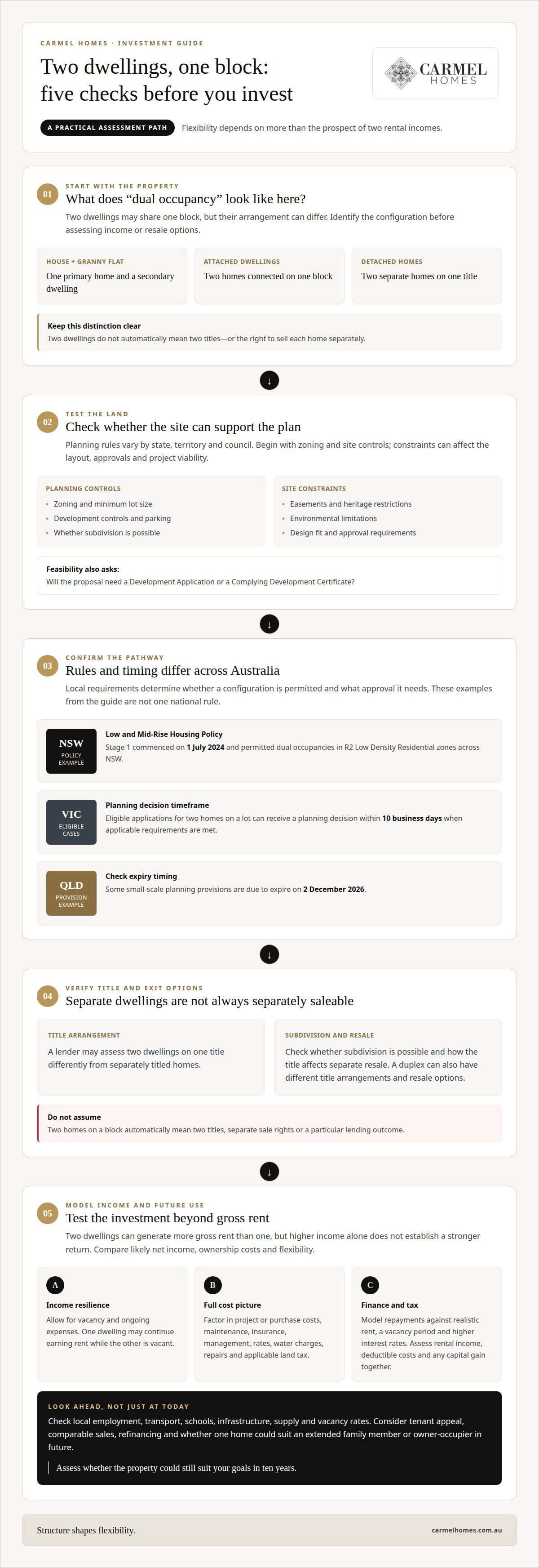
Approvals, title arrangements and subdivision restrictions
Australian dual occupancy rules vary by state, territory and council. Start by assessing zoning and site controls, then consider approval, title and subdivision options.
Zoning and Approval Pathways
Planning pathways determine whether a proposed dual occupancy configuration is permitted and what approval it needs. There is no single national rule: state and territory frameworks interact with local planning controls. In NSW, Stage 1 of the Low and Mid-Rise Housing Policy commenced on 1 July 2024 and permitted dual occupancies in R2 Low Density Residential zones across NSW. In Victoria, eligible applications for two homes on a lot can receive a planning decision within 10 business days when applicable requirements are met. Some Queensland small-scale planning provisions are due to expire on 2 December 2026.
Site Suitability and Feasibility
Site suitability means assessing whether the land and its constraints can accommodate two dwellings under applicable planning controls. Before purchase or design, examine zoning, minimum lot size, development controls, parking, easements, heritage restrictions and environmental limitations. These factors can affect the layout, approval pathway and project viability. A feasibility assessment also considers whether a Development Application or Complying Development Certificate is required, and whether subdivision is possible.
For a proposed build, first assess planning controls and site constraints. Then test the design and subdivision feasibility, and confirm which approvals may be needed before construction.
Title Arrangements and Subdivision Restrictions
Title arrangements determine whether both dwellings remain together or can be held separately. A dual occupancy may sit on one title or, where the block and council allow, be subdivided onto two titles. Separate titles may create distinct ownership and resale options, but having two dwellings does not itself permit separate sales. Subdivision depends on planning requirements and council approval, so base your exit strategy on the actual title structure.
Planning rules can vary between local councils, even within the same state. Reviewing the title and approvals helps clarify permitted use, occupancy and rental restrictions before a purchase or resale decision.
Dual occupancy property types
Australian dual occupancy properties come in several forms, each affecting privacy, rental use and future flexibility. Two homes on one block do not necessarily mean separate titles, independent resale options or identical cash flow.
House and granny flat
A house with a granny flat pairs a primary residence with a smaller second dwelling on the same block. An investor might rent both homes, live in one and lease the other, or use the arrangement for extended family. The property’s title and approved use determine how it can be occupied. Assess each dwelling’s rent and upkeep separately when estimating cash flow.
Attached and detached dwellings
Two attached dwellings share a wall, while two detached homes stand separately on one block. Both configurations provide two homes, but their layouts offer different levels of separation and privacy. For example, front-and-back dwellings may have distinct entries and outdoor areas, while side-by-side homes may relate more evenly to the street. The design, site and approval conditions determine how each dwelling functions.
Duplex-style developments
A duplex is a form of attached dual occupancy, often designed with subdivision and separate resale in mind. That intention does not establish that separate titles or sales are permitted. Planning controls and title arrangements remain central. Distinguish projected rental income from a future subdivision outcome, particularly when assessing the property within a wider portfolio.
Dual-key homes
A dual-key home divides one residence into two self-contained homes, with a shared entrance foyer and separate internal access. Unlike two fully independent dwellings, occupants use a common entry area. The arrangement may suit tenants seeking separate living spaces, but the shared configuration can affect privacy and future buyer appeal. Consider how it works for rental use and owner-occupation rather than assuming it offers the same flexibility as detached homes.
To shape a layout around intended use, explore a bespoke dual occupancy design that responds to the site and household needs.
Carmel Homes: Dual Occupancy
Carmel Homes offers dual occupancy for homeowners considering two dwellings as part of a carefully planned property project. Once you have weighed rental potential against planning, title and future-use constraints, a tailored design can help translate those priorities into a considered home design.
Through Custom Design and Build, Carmel Homes develops a project around your brief, whether you are planning a new build or exploring a knockdown rebuild. The design process can consider how each dwelling will function, how the layout supports privacy and how the homes may suit changing household needs. It is a natural next step when you are ready to explore a dual occupancy project shaped around your site and intentions.
Please contact Carmel Homes to discuss your dual occupancy plans.
Shape the next stage of your property plans
Decide how the property should serve you over time, not only at purchase. For dual occupancy as a property investment strategy, define the intended balance between rental use, household needs and future flexibility before design choices are fixed. A clear brief brings those priorities into focus and guides the conversation about the home you want to create.
Carmel Homes offers Custom Design and Build, Knockdown Rebuild and French Provincial Luxury Homes, giving you a considered starting point for shaping a dual occupancy project around your vision. If you are ready to explore how your plans could take form, Discuss your plans with Carmel Homes. A thoughtful first conversation can help you move forward with clarity and confidence.
Frequently Asked Questions
What are the typical costs and rental yields for dual occupancy properties in Australia?
There is no single typical cost or yield for Australian dual occupancy properties. Total costs depend on the site, design, construction, approvals and any subdivision work, while rental yield relates expected rent to the full investment cost. For a useful comparison, model each dwelling’s rent separately, then account for vacancy, insurance, rates, management and maintenance before assessing the resulting income.
What are the building, subdivision, and occupancy requirements for dual occupancy properties?
Requirements depend on the state or territory, local planning controls and the property’s approved configuration. A project may need a Development Application or Complying Development Certificate, and subdivision requires relevant planning approval. Before purchase or construction, establish the approved use, title arrangement and any occupancy or rental restrictions. Site constraints such as easements, heritage controls, parking and environmental limits can also affect the design.
What are the main risks and drawbacks of dual occupancy as an investment strategy?
Using dual occupancy as a property investment strategy brings exposure to vacancies in either dwelling, changing interest rates and the costs of maintaining two homes. Separate tenancies can add management work, including inspections, repairs and tenant communication. Another risk is assuming both dwellings can be sold separately: this depends on title and subdivision permissions. Stress-test cash flow against vacancies and higher repayments before committing.
What planning and zoning rules apply to dual occupancy in each Australian state and territory?
Rules vary by state, territory and council, so check local zoning, site controls and approval requirements. NSW Stage 1 of the Low and Mid-Rise Housing Policy commenced on 1 July 2024 and permitted dual occupancies in R2 zones across NSW; eligible Victorian applications may receive a decision within 10 business days when requirements are met; some Queensland small-scale planning provisions are due to expire on 2 December 2026.
What insurance, land tax, council rates, and ongoing maintenance costs apply?
Allow for insurance, applicable land tax, council rates, water charges, maintenance and repairs to shared infrastructure. No cost amounts are provided here; assess these alongside management costs and realistic rent for each dwelling.


