


Custom Home Building Contracts, Stages, Costs and Cover
Updated: 4 days ago
Building a custom home moves from design and approvals into construction, with progress payments tied to completed stages rather than calendar dates in Victoria. The Domestic Building Contracts Act 1995 defines five on-site stages: base, frame, lock-up, fixing and completion. A custom home building contract explained in plain terms sets out the work, price or pricing method, timing, payment structure, variations, permit responsibilities and insurance that apply to those stages.
That structure matters because a bespoke home brings design decisions, site conditions and approvals together, and changes can affect both cost and timing. Clear contract terms show who is responsible for each part of the process before construction begins.
This guide explains the build stages, contract requirements that apply in Australia and how design-and-build arrangements connect architectural vision with construction. It also outlines how contract pricing works and what insurance or warranty cover may apply, helping you approach a major investment with greater clarity.
Table of Contents
Home warranty insurance and domestic building insurance
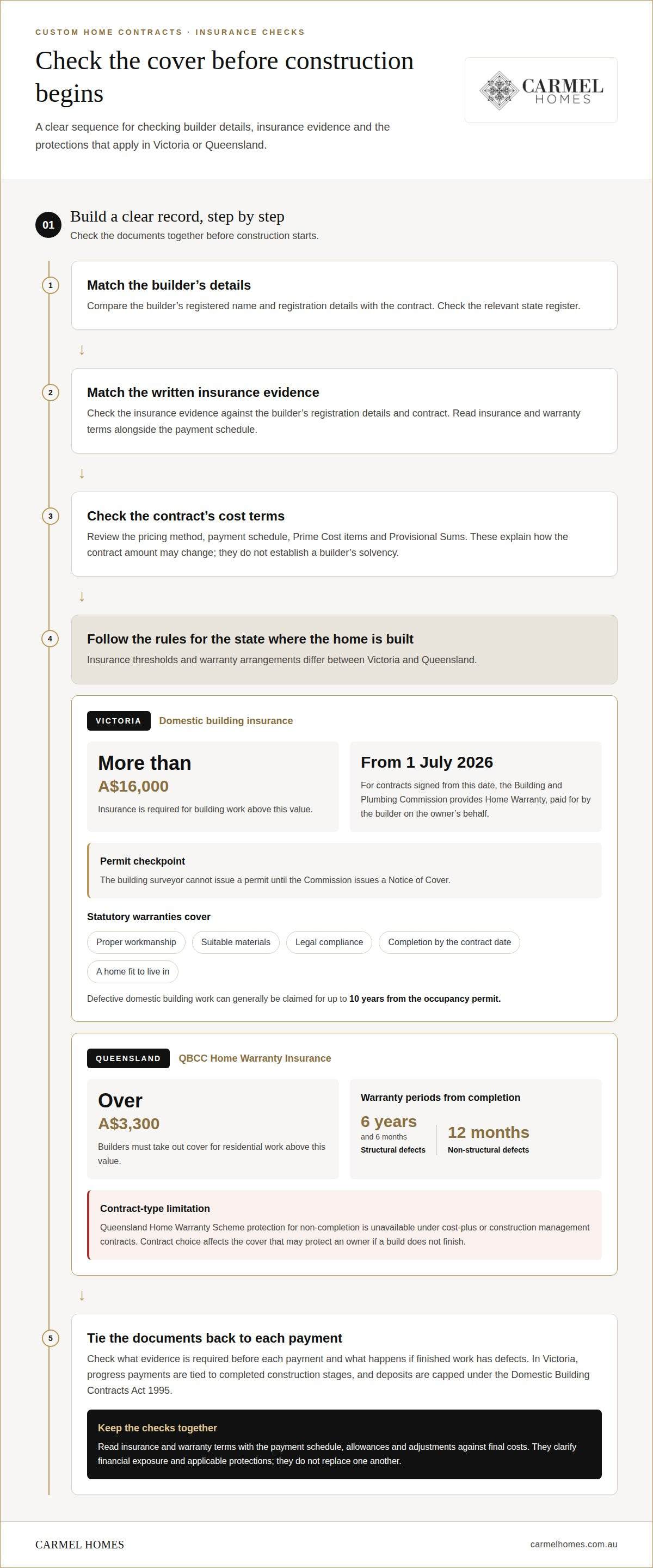
Before construction begins, compare the builder’s registered name and registration details with the contract. Check the relevant state register and match those details against written insurance evidence. To understand the financial terms, review the pricing method, payment schedule, Prime Cost items and Provisional Sums. These explain how the contract amount may change, but do not establish a builder’s solvency.
In Victoria, domestic building insurance is required for building work worth more than A$16,000. For Victorian contracts signed from 1 July 2026, the Building and Plumbing Commission provides Home Warranty, paid for by the builder on the owner’s behalf. The building surveyor cannot issue a permit until the Commission issues a Notice of Cover. Victoria’s statutory warranties cover proper workmanship, suitable materials, legal compliance, completion by the contract date and a home fit to live in. Defective domestic building work can generally be claimed for up to 10 years from the occupancy permit.
Queensland has a separate arrangement. Builders must take out QBCC Home Warranty Insurance for residential work over A$3,300. Statutory warranties cover structural defects for 6 years and 6 months from completion, and non-structural defects for 12 months from completion. However, Queensland Home Warranty Scheme protection for non-completion is unavailable under cost-plus or construction management contracts. Contract choice therefore affects the cover that may protect an owner if a build does not finish.
Read the insurance and warranty terms alongside the payment schedule, not as a substitute for it. In Victoria, progress payments are tied to completed construction stages, while deposits are capped under the Domestic Building Contracts Act 1995. The contract should identify relevant warranties, insurance, allowances and how prime cost items or provisional sums are adjusted against final costs. Check what evidence is required before each payment, and what happens if the finished work has defects. These details clarify the owner’s financial exposure and the protections that apply at each stage.
What are the stages of building a custom home?
Contract pricing determines how design decisions, construction costs and progress are managed. The key distinction is whether the agreed price covers defined work or changes with actual costs.
Plans, specifications and variations
Plans and specifications define the work, materials and finishes included in the contract. A fixed price generally covers only this documented scope. Before signing, compare the drawings with the written specifications, including fixtures, fittings and custom details. Prime Cost items and Provisional Sums are allowances for items or work that have not yet been precisely costed. Check how the contract adjusts the amount when actual costs differ.
A fixed-price contract sets a price for the documented scope. A cost-plus contract charges actual construction costs plus an agreed fee or percentage. With cost-plus, the final amount can change as labour, materials and other eligible costs accrue. A fixed price offers greater certainty for included work, but not for exclusions or later changes. Unclear allowances, unforeseen site conditions and omitted work can also lead to extra costs.
Record each proposed variation in writing before the work proceeds, including its price and effect on timing. This gives both parties a clear record of the revised scope.
Contract review and administration
Contract review means comparing the drawings, specifications, pricing method and terms before signing. Careful administration then tracks costs and progress against those agreed documents. Read the scope alongside every allowance, payment milestone, exclusion and variation clause. Resolve inconsistencies in writing before signing, then keep the complete signed contract and approved changes together.
During construction, keep a cost record of payments, variations and adjustments to Prime Cost items or Provisional Sums. Compare each progress claim with the completed work and contract schedule. This can help you spot differences early, before several claims have accumulated.
If a builder claims a delay in Victoria, the claim must state its reason and requested extension. The builder must provide it within 15 business days after the delay ceases; the owner generally has 10 days to respond in writing. For a disputed variation or alleged breach, preserve the contract and correspondence, follow its notice and dispute clauses, and document the issue. Cancellation depends on the contract’s termination terms and applicable law; don’t assume either party can end it without following the required process. To explore how custom home plans can be developed into a documented build scope, consider the design stage alongside these contract details.
Written domestic building contract requirements
Written contract rules differ between Victoria and Queensland, so the state where the home is built matters. A complete agreement records the scope, price, timing and responsibilities before construction starts.
When written contracts are required
Written contract requirements set out when domestic building work must be documented, helping both parties establish agreed terms before work begins. In Victoria, a contractor must have a written contract for building work, regardless of size or price. A major domestic building contract is required before work starts when the project involves more than one trade and is worth more than A$10,000.
In Queensland, a written contract is required for domestic building work valued over A$3,300, including labour, materials and GST. Contracts must be dated and signed by both parties before work begins. For work costing more than A$20,000, the contractor must provide the QBCC Consumer Building Guide before signing.
Contract clauses and requirements
Contract clauses describe the work, price and build process. Clear terms help prevent disputes over what the agreed amount includes. A Victorian major domestic building contract must use plain language, fully describe the work, state the price or calculation method, and set out start and completion dates.
Include architectural drawings, specifications, payment schedule, progress stages, variation process, permit responsibilities, warranties and insurance. Queensland Level 2 contracts must state how the price is calculated when it is not fixed, including allowances. The contract should also identify who handles approvals and explain how delays affect the estimated completion timeframe.
Written variations and change management
A written variation records an agreed change to the original contract, including its cost and effect on timing. In Victoria, changes made after signing must be documented in a written variation signed by both parties, stating the price and time implications.
Before changed work proceeds, compare the variation with the plans and specifications, then keep the signed record with the contract. For example, a revised finish selection should identify the replacement material, any price change and whether the construction schedule is affected. This gives both parties a shared record for progress claims and cost tracking.
Design-build contracts
A design-and-build contract combines architectural design services and construction under one agreement. It connects the design and construction process, making clear documentation of the scope, decisions and price especially important.
In this arrangement, the builder controls the design. That can simplify coordination between drawings and construction, while also reducing cost transparency or compromising the original architectural vision. The central question is not simply whether one contract feels convenient. It is whether the documented process protects your priorities from initial concept through completed home.
Before signing, identify what design work the agreement includes and how your brief will be translated into plans. The contract should define the scope, specifications, materials, finishes and custom features rather than relying on broad descriptions. For example, a reference to a stone kitchen island should be supported by details that clarify its dimensions, finish and inclusions.
Establish how design decisions affect the price. If the contract uses allowances for selections, record what each allowance covers and how a difference from the final selection changes the amount payable. Ask how design revisions are documented, priced and approved, and whether they may affect the construction timetable. Written records make the connection between a design change and its cost easier to follow.
The contract should also define responsibility for approvals: who prepares and lodges permit applications, who responds to approval conditions, and how those requirements affect the drawings and construction scope. If a permit requirement changes the documented design, the change may affect cost or timing. Clear terms explain how both parties will manage it.
Design-and-build can suit owners who value a coordinated process from design through construction and are comfortable with the builder directing design development. If you have a strong architectural brief, focus on design approval points, scope documentation and cost visibility. Consider whether each stage preserves the qualities that matter to you, rather than assuming one agreement automatically ensures alignment. Internationally, bespoke residential builders like Vancouver Custom Homes follow similar principles, showing how early coordination between designers and builders helps align bespoke concepts with construction budgets.
For a considered design-and-build discussion, explore a custom home design and build shaped around your architectural priorities.
Carmel Homes: Custom Design and Build
Carmel Homes is a natural next step if you want one considered process to carry your home from individual design into construction. Its Custom Design and Build offering can help translate your priorities into a residence shaped around your site, architectural preferences and way of living, rather than a standard plan.
For a rebuild on your existing block, Carmel Homes also offers Knockdown Rebuild. French Provincial Luxury Homes and Modern Custom Home Designs provide distinct design directions, with scope to create a home that feels personal. Discuss your vision, site and preferred approach, then consider how to document the design and build together.
To begin a conversation about your custom home, visit carmelhomes.com.au.
Shape the next chapter of your home
Start by turning your ideas into a clear brief: how you want the home to feel, what matters most in its design and how the site may shape the result. A custom home building contract explained in relation to those priorities is easier to assess, because you can judge the proposed scope and design decisions in context.
Carmel Homes offers Custom Design and Build, Knockdown Rebuild and French Provincial Luxury Homes, providing distinct starting points for shaping a home around your aspirations. A conversation can help you explore which direction suits your plans, whether you are building a new residence or considering a rebuild.
Contact Carmel Homes to discuss your plans and take a considered first step towards a home that feels distinctly yours.
Frequently Asked Questions
What do base, frame, lock-up and fixing stages mean?
These terms describe construction milestones used to organise work and progress claims. Base refers to the foundation stage; frame, to the home’s structural frame; lock-up, to when the building is enclosed and secured; and fixing, to internal fittings and finishes. The contract’s stage descriptions determine what must be complete before a payment claim is made, so compare each milestone with the documented scope.
What happens before construction starts on a custom home?
Before building begins, the design and scope are developed, permits are obtained, and the contract and required insurance are put in place. In Victoria, construction cannot legally start without a building permit, and a registered building surveyor assesses the application. A custom home building contract explained through these pre-construction responsibilities clarifies who handles permits, engineering certifications, inspections and occupancy certification before site work begins.
What is a custom home building contract in Australia?
A custom home building contract is the written agreement setting out the owner’s and builder’s obligations for designing and constructing a tailored residence. A custom home building contract explained in practical terms connects the agreed plans and specifications with the pricing method, payment arrangements, timing and process for changes. For example, documenting an essential finish helps distinguish an included selection from a later variation.
What deposits and progress payments are allowed under Australian home building laws?
Deposit limits and payment rules depend on the state and contract type. Deposit limits and payment rules can vary by state and contract type, so check the applicable requirements and contract terms before agreeing to a deposit. In Victoria, deposits are capped under the Domestic Building Contracts Act 1995, while progress payments are tied to completed construction stages. A payment schedule should show the amount and milestone for each claim, rather than relying on calendar dates alone.
What warranties and statutory protections apply to custom home building contracts in each Australian state?
Statutory protections differ across states and territories, so a single national warranty period does not apply. In Queensland, statutory warranties cover structural defects for 6 years and 6 months from completion, and non-structural defects for 12 months from completion. In Victoria, defective domestic building work can generally be claimed for up to 10 years from the occupancy permit. Other jurisdictions have their own applicable rules and schemes.


